

Latest News
-
1Human Resources Strategy
Leadership Evaluation: What It Is, How It Works, and How It Can Drive Your Company Forward
-
2Recruiters and Employers
Executive Talent Shaping the Modern Enterprise
-
3Trends and News
What Leadership in the Era of AI Actually Demands
-
4Workaholics
How to Do Networking Strategically
October 7, 2024
Employee Turnover: Causes and Solutions to This Problem
An employee’s resignation represents a loss in more than one sense. Not only is a position left vacant, but time and budget must be invested to find someone who fits the position, hire them, and train them. On average, companies lose an average of 20% of productivity per employee during the three to six months following hiring.
A high employee turnover rate is a serious problem in any organization. It is necessary to understand this phenomenon well in order to provide an adequate solution. At Talent2Win, we are a recruitment agency with extensive experience in talent selection and management, so we are familiar with this problem.
Here we will explore the main causes of employee turnover, how to calculate the turnover rate, and most importantly, what solutions companies can implement to reduce it.
What is employee turnover?
Employee turnover refers to the constant departure of workers from a company. High turnover can generate a series of problems ranging from increased recruitment and training costs to a decrease in productivity and team morale. The best way to understand the magnitude of the problem is through the employee turnover rate.
Employee turnover rate
The employee turnover rate is the KPI that allows us to calculate the percentage of workers who have left the company during a specific period. This is, perhaps, the most important indicator in Human Resources, as it helps us to identify the quality of talent management and the effectiveness of recruitment and selection practices.
How to calculate the employee turnover rate?
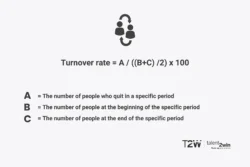
The formula for the employee turnover rate is quite simple. To apply it, you must first identify the value of three variables that occurred within your company in a defined period of time:
- A = The number of employees who resigned in a specific period
- B = The number of employees at the beginning of the specific period
- C = The number of employees at the end of the specific period
Steps to calculate the percentage of employee turnover
- Once the value of the three variables has been identified, you must first add the number of employees at the beginning of the period (B) to the number of employees at the end of the same period (C). The result of the sum must be divided by 2.
- Then, the result of this first operation must be divided by the number of employees who resigned in the same period (A).
- Finally, the result of this second division must be multiplied by 100 in order to obtain the percentage of employee turnover.
The formula for calculating the turnover rate is as follows:
Turnover rate = employees who resigned / ((employees at the beginning + employees at the end) /2) x 100
Remember that this must always be done within the framework of a specific period.
How to interpret the turnover rate?
A high turnover rate indicates that the company is experiencing a significant loss of talent, which can have negative consequences on performance and organizational culture. On the contrary, a low rate suggests that employees are more satisfied and committed to the company.
It is important to note that an acceptable turnover rate can vary depending on the industry, the size of the company, and other factors. However, in general, a turnover rate below 10% is considered healthy.
Causes of Employee Turnover
The first step in addressing the issue of employee turnover is understanding the reasons why employees choose to leave a company. Some of the most common causes are:
1. Poor Recruitment Strategy
The most common cause of a high turnover rate is a flawed recruitment strategy. Why is this? Some inexperienced recruitment teams fail to accurately convey the company’s offer during the selection process. This causes candidates to enter the company with one idea in mind and encounter a different reality once inside.
On other occasions, there is a failure to conduct proper candidate sourcing to identify the person who truly fits the company’s culture. As a result, the candidate does not match the organization’s work philosophy and ends up leaving.
2. Lack of Growth Opportunities
In the modern workplace, employees are constantly seeking new professional development opportunities. Let’s not forget that younger age groups like Gen Z and Millennials place a great emphasis on strengthening their careers. If they cannot find these opportunities in their current company, they are likely to seek employment elsewhere.
3. Lack of Recognition
Recognition from our peers is a basic need clearly represented in Maslow’s hierarchy of needs. Accordingly, employees need to feel valued and recognized for their work. Lack of recognition can lead to frustration and demotivation, which can trigger a resignation.
4. Poor or Nonexistent Leadership
A toxic boss or an ineffective leadership style can be one of the main reasons why employees decide to resign. Sometimes, the deficiency or absence of adequate leadership results in a poor work environment. This is often synonymous with a high turnover rate.
Solutions to Prevent Employee Turnover
These are the measures that can address the causes of employee turnover:
1. Outsourcing Recruitment
When the internal HR team does not have the experience or time to carry out a good recruitment process, it is necessary to opt for recruitment outsourcing. A talent acquisition agency usually has recruiters who are experts in identifying all types of profiles in various sectors. This can undoubtedly help you reduce turnover and optimize your processes.
2. Creating a Professional Development Plan
Offering training and professional development opportunities is essential to retain talent. Every employee wants to have a career path, professional goals to aim for, or the prospect of constant learning. To achieve this, measures such as a system of promotions, mentoring programs, training, etc. can be taken.
3. Implementing Recognition Programs
Recognizing and rewarding employee achievements is an effective way to increase their motivation and commitment. We cannot forget that human beings need recognition from their peers. A good employee recognition program is the best solution here to address turnover.
4. Identifying Effective Leaders
To identify a poor work environment triggered by poor leadership, it is necessary to conduct employee satisfaction surveys. These allow you to identify areas for improvement and take measures to address problems before employees decide to resign.
Now, if you find that the cause of the problem is poor leadership, it is necessary to address the problem at its core. Ideally, your company should have leaders who fit your culture and values. For this, it is advisable to opt for a careful and detailed recruitment process that allows you to identify talent with the soft and hard skills that a leader requires.
Additionally, it is necessary not only to hire experienced decision-makers but also to train capable leaders who make use of effective leadership, empathetic leadership, and leadership in times of change. This will allow you to dramatically improve the work environment and reduce turnover rates.
Let’s Recap
Employee turnover is a complex problem that requires a comprehensive solution. By identifying the underlying causes and applying the appropriate strategies, companies can reduce the loss of talent, improve productivity, and create a more positive work environment. It is important to remember that employee turnover is not always negative. Sometimes, workers leave for personal reasons or to seek new opportunities. However, an excessive turnover rate can be an indicator of deeper problems within the organization. By taking proactive measures to reduce turnover, you can build more stable and committed teams.
Talent2Win offers borderless talent consulting solutions tailored to your company. If you would like to learn about our Executive Search, Talent Acquisition or RPO services, please do not hesitate to contact us.
