

Latest News
-
1Human Resources Strategy
Headhunting: When it is advisable to outsource Executive Search
-
2Recruiters and Employers
Executive Talent Shaping the Modern Enterprise
-
3Trends and News
What Leadership in the Era of AI Actually Demands
-
4Workaholics
What is the Imposter Syndrome (and How to Overcome It)
November 13, 2026
What is the Imposter Syndrome (and How to Overcome It)
Imposter syndrome is a pervasive cognitive pattern where individuals doubt their accomplishments and harbor an internalized fear of being exposed as a “fraud.”
Research published in the International Journal of Behavioral Science reveals that 70% of people experience imposter syndrome at some point in their careers.
It affects professionals across all career stages, from entry-level workers navigating new roles to C-suite leaders making high-stakes decisions. Left unaddressed, it leads to burnout, career stagnation, and reduced workplace productivity.
All of these negative consequences can be mitigated through structured feedback, objective diagnostic tools, and supportive workplace cultures.
In Talent2Win, as a recruitment company, we know this problem an the way it can affect the best talent. In this article, we will delve into the imposter syndrome, its different types, and how to overcome it.
The Internal Friction Holding Professionals Back
Have you ever accepted a promotion, completed a major project, or stepped into a new meeting room, only to be hit by a sudden feeling that you don’t actually belong there? If so, you are experiencing one of the most widespread yet rarely discussed hurdles in the modern workplace.
According to research published in the International Journal of Behavioral Science, a striking 70% of professionals struggle with imposter syndrome at least once during their careers.
Furthermore, a global study by KPMG revealed that 75% of executive women have personally navigated acute imposter feelings while stepping into major leadership roles.
The core challenge of imposter syndrome is that it makes success feel like a fluke rather than the result of hard work and skill. Professionals suffering from it often credit their wins to “good luck,” “being in the right place at the right time,” or “tricking people into thinking they’re smart.”
For individuals, this creates constant anxiety and limits career growth. For organizations, it drains employee engagement, stalls creative risk-taking, and leads to the burnout syndrome.
The path forward requires shifting from silent internal evaluation to objective, data-backed self-awareness. By understanding the root causes of imposter feelings and leveraging clear developmental tools, both employees and companies can turn self-doubt into a foundation for genuine confidence.
The 5 Types of Imposter Syndrome Across Career Levels
Dr. Valerie Young, a leading expert on the subject, identified five distinct competence types that explain how imposter syndrome manifests in different people across an organization:
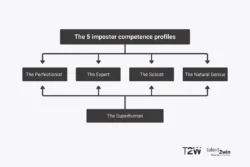
1. The Perfectionist
Believes that unless a task is executed flawlessly, it is a failure. Even a 99% success rate feels like a personal shortcoming.
2. The Expert
Feels they must know every single detail before starting a project. They hesitate to apply for jobs or promotions unless they meet 100% of the criteria.
3. The Soloist
Feels that asking for help proves they are incompetent. They insist on accomplishing everything completely on their own.
4. The Natural Genius
Expects mastery on the very first try. When something takes time or effort to learn, they interpret it as proof of lack of talent.
5. The Superhuman
Pushes themselves to work harder than everyone else to prove they aren’t a fraud, often leading to severe work-life imbalance and burnout.
How Imposter Syndrome Affects Different Career Stages
Imposter syndrome doesn’t disappear with age or tenure, it simply shifts forms as your career progresses:
-
Entry-Level & Early Career
Early professionals often feel overwhelmed by “subject-matter jargon” and fear asking clarifying questions, worrying it will reveal their lack of experience.
-
Mid-Level & Specialists
As managers and specialists take on broader project ownership, they frequently struggle with delegation, assuming they must do everything themselves to maintain quality.
-
Executive & C-Suite Talent
High-level decision-makers often face the “lonely at the top” phenomenon. When guiding teams through ambiguous market conditions, admitting uncertainty can feel like revealing weakness.
|
You might like: Types of leadership in businesses |
Actionable Strategies to Overcome the Imposter Syndrome
Whether you are an individual working through self-doubt or an enterprise manager looking to support your team, these practical strategies build lasting confidence:
For Professionals
-
Separate Fact from Feeling
Acknowledge feelings of anxiety without accepting them as truth. Feeling unqualified does not make you unqualified.
-
Keep a Wins Ledger
Maintain a dedicated folder of positive performance reviews, successful project metrics, and peer praise to review whenever self-doubt spikes.
-
Reframe Failure as Growth
Shift your mindset from needing to be smart to needing to learn. Growth requires making mistakes along the way.
For Organizations & Leaders
-
Deploy Objective Diagnostics
Use standardized feedback models like 360-degree evaluations and psychometric tools (DISC, Hogan Assessments) to give employees clear, unvarnished data about their actual strengths and performance.
-
Foster Psychological Safety
Create team environments where asking for help and sharing lessons learned from mistakes are celebrated rather than penalized.
-
Define Clear Performance Benchmarks
Vague expectations breed imposter feelings. Establishing clear, measurable KPIs gives employees concrete proof of their daily contributions.
Let’s Recap
Imposter syndrome is not a personal failure or a sign that you don’t belong; it is often the natural byproduct of stretching beyond your comfort zone to take on new challenges. For professionals at any stage of their career, recognizing these thought patterns is the first step toward breaking free from them.
Talent2Win offers borderless talent consulting solutions tailored to your company. If you would like to learn about our Executive Search, Talent Acquisition or RPO services, please do not hesitate to contact us.
