

Latest News
-
1Human Resources Strategy
Leadership Evaluation: What It Is, How It Works, and How It Can Drive Your Company Forward
-
2Recruiters and Employers
Executive Talent Shaping the Modern Enterprise
-
3Trends and News
What Leadership in the Era of AI Actually Demands
-
4Workaholics
How to Do Networking Strategically
Related
-
Leadership Evaluation: What It Is, How It Works, and How It Can Drive Your Company Forward
Lorem ipsum dolot sit amet consectur dolor
-
Modern Recruitment Problems and Solutions You Can Not ignore
Lorem ipsum dolot sit amet consectur dolor
-
Recruitment strategy: 5 keys to transforming your organization.
Lorem ipsum dolot sit amet consectur dolor
May 20, 2025
Organizational Change Management: Keys to a Successful Business Transformation
We all know that the ability to adapt to change is crucial for the survival and success of any organization. This is especially relevant in today’s business landscape. With the constant emergence of new technologies, companies find themselves needing to change and adapt, which is not always easy.
In this context, organizational change management has become an essential discipline to help companies navigate transformations effectively, minimizing resistance and maximizing adoption. In fact, according to a Prosci study, organizations with effective change management are 6 times more likely to achieve their project objectives.
Are you familiar with change management in companies? At Talent2Win, we specialize in headhunting recruitment, so we are key players in the change and transformation of companies from their most fundamental core: human talent. In the following article, we will delve into change management, its operation, and its main models.
What is Organizational Change Management?
Organizational change management is the structured process by which an organization and its employees are guided through a transition from the current state to a desired state. For this, the process involves planning, implementing, and monitoring strategies to minimize resistance, maximize adoption, and ensure that change is sustainable in the long term.
Microsoft is a great example of change management in a company. Under the leadership of Satya Nadella, Microsoft underwent a significant cultural transformation, moving from a software-centric company to a cloud services company.
Pillars of Successful Change Management
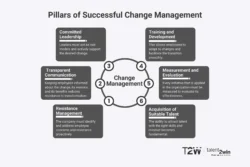
While there are many different strategies and models to apply change management in a company, there are some key steps:
-
Resistance Management
In general terms, change is never easy for people. Therefore, part of the strategy should include managing resistance from employees. A McKinsey report revealed that 70% of change initiatives fail due to employee resistance.
To avoid this, the company must identify and address employee concerns and resistance proactively. For this, surveys can be conducted before, during, and after implementing changes in the organization.
-
Clear and Transparent Communication
Change must occur at all levels of the organization and, to make it easier for everyone, they must be aware of the importance of this initiative. Keeping employees informed about the change, its reasons, and its benefits reduces resistance to transformation.
-
Committed Leadership
The importance of leadership in times of change cannot be overlooked. When it comes to facilitating organizational transformation, leaders must act as role models and actively support the desired change.
-
Training and Development
Depending on the nature and scope of the change, the transformation process will require specific knowledge and skills from employees. For this, part of the strategy involves the constant training of people in the company. This allows employees to adapt to changes and facilitate the transition smoothly.
-
Measurement and Evaluation
Every initiative that is applied in the organization must be measured to evaluate its effectiveness. To begin, it will be necessary to establish metrics to assess the progress of the change. Then, as the selected model is applied, the metrics should be reviewed and the process analyzed. This allows adjustments to be made as necessary and ensures the effectiveness of the measures.
-
Acquisition of suitable talent
In times of transformation, the ability to attract talent with the right skills and mindset becomes fundamental. Therefore, strategic recruitment of professionals at all levels will be key (regular recruitment and headhunting processes). For example, in a context of technological changes, it is necessary to attract professionals with experience in emerging technologies and the ability to drive digital transformation.
Change Management Models
1. Lewin’s Model
Also known as Unfreeze-Change-Refreeze, it focuses on three crucial stages for the successful implementation of change.
- First, the “Unfreeze” stage involves preparing the organization for change, questioning the actions followed so far, and creating awareness of the need for transformation.
- Then, the “Change” stage focuses on the implementation of the changes themselves. This includes clear communication and adequate training for employees.
- Finally, the “Refreeze” stage aims to consolidate the changes, ensuring that they become the new normal and are integrated into the organizational culture.
2. ADKAR Model
ADKAR stands for Awareness, Desire, Knowledge, Ability, and Reinforcement. This model focuses on individual change, ensuring that each person goes through five stages for a successful transition.
- “Awareness” is the first step, where each individual seeks to understand the need for change.
- “Desire” is the second stage, where motivation and commitment to change are sought.
- “Knowledge” refers to the acquisition of the skills and information necessary to implement the change.
- “Ability” refers to the ability to put the acquired knowledge into practice.
- Finally, “Reinforcement” seeks to consolidate the change through positive feedback and recognition.
3. Kotter’s 8-Step Model
This model proposes a sequence of actions to lead change effectively.
- The first step is to create a sense of urgency, communicating the need for change clearly and convincingly.
- The second step is to form a guiding coalition, a team of influential people who lead the change process.
- The third step involves creating a vision for change, defining the objectives and the path to follow.
- The fourth step requires communicating the vision effectively, ensuring that all members of the organization understand it.
- The fifth step is to remove obstacles that may hinder change.
- The sixth step requires generating short-term wins, celebrating achievements to maintain motivation.
- The seventh step is to consolidate achievements, ensuring that changes are maintained in the long term.
- Finally, the eighth step is to anchor the change in the organizational culture, ensuring that it becomes part of the company’s identity.
Let’s recap
Organizational change management is a complex process that requires a strategic approach and effective communication. By prioritizing employee participation, committed leadership, and continuous adaptation, organizations can navigate transformations successfully and build a more prosperous future. The strategic integration of recruitment and headhunting in this process can ensure the incorporation of the talent necessary to drive and sustain the transformation.
Talent2Win offers borderless talent consulting solutions tailored to your company. If you would like to learn about our Executive Search, Talent Acquisition or RPO services, please do not hesitate to contact us.
