

Latest News
-
1Human Resources Strategy
Leadership Evaluation: What It Is, How It Works, and How It Can Drive Your Company Forward
-
2Recruiters and Employers
Executive Talent Shaping the Modern Enterprise
-
3Trends and News
What Leadership in the Era of AI Actually Demands
-
4Workaholics
How to Do Networking Strategically
Related
-
Leadership Evaluation: What It Is, How It Works, and How It Can Drive Your Company Forward
Lorem ipsum dolot sit amet consectur dolor
-
Modern Recruitment Problems and Solutions You Can Not ignore
Lorem ipsum dolot sit amet consectur dolor
-
Recruitment strategy: 5 keys to transforming your organization.
Lorem ipsum dolot sit amet consectur dolor
May 23, 2025
Organizational Resilience: Thriving in Adversity and Uncertainty
In a business environment marked by volatility and uncertainty, an organization’s ability to adapt and thrive in the face of challenges has become a critical success factor. Have you ever wondered: How resilient is my company really?
Resilience is a concept that is applied in the business environment with great results, but you have to know how to apply it. At Talent2Win, we specialize in talent acquisition and management, so we know the subject well. In the following article, we explore the fundamentals of organizational resilience, its benefits, and how to cultivate it in your company.
What is Organizational Resilience?
Organizational resilience is the ability of a company to recover and grow from adversity. It’s not just about withstanding blows, but about learning from them and emerging stronger. We are talking about a quality that distinguishes leading companies from the rest.
For this, it is necessary that the company can anticipate possible changes, prepare to face them, and offer appropriate and timely responses. The goal is not only to overcome changes, but to thrive in the face of them.
The results are evident: According to a Deloitte study, companies with high resilience are 50% more likely to outperform their competitors in terms of profitability.
Examples of Organizational Resilience
It is easier to notice the real importance of organizational resilience when you see its effects on other companies.
-
Resilience in a company: Netflix
We all know Netflix and its important presence among streaming platforms. However, streaming was never its initial core business. In fact, this company started in the late 90s with a DVD rental proposal. As we know, DVDs disappeared from the market, so Netflix, making great use of organizational resilience, adapted to the world of streaming. That is a great example of the ability to anticipate and respond to market changes.
-
Resilience in a company: IBM
In its beginnings, around 1930, IBM was a company that was dedicated to manufacturing typewriters. As you can imagine, that business would not have a long-term future, since in the late 70s computers would begin to revolutionize the way of working. Due to changes in the market, the company transformed throughout its history, going from manufacturing typewriters to being a leader in technology and consulting services.
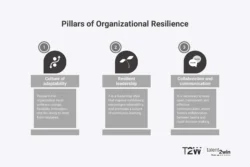
Pillars of Organizational Resilience
-
Culture of adaptability
Culture has a significant level of influence on the actions of any company. Workers in it must embrace change and make adaptability one of their personal characteristics. For this it is necessary to design an organizational culture that values flexibility, innovation, and the ability to learn from mistakes.
-
Resilient leadership
Although there are many types of leadership, all of them valid, here a very specific one is needed: resilient leadership. It is a leadership style that inspires confidence, encourages adaptability, and promotes a culture of continuous learning.
-
Collaboration and communication
It would be very difficult for any company to adapt to every change if its teams do not communicate effectively with each other to change course, strategy, or approach. Therefore, it is necessary to maintain open, transparent and effective communication, which fosters collaboration between teams and rapid decision-making.
Benefits of Organizational Resilience
-
Greater adaptability
Resilient organizations are able to adapt quickly to market changes and unexpected disruptions. In fact, according to a McKinsey report, companies that invest in resilience are 30% less likely to experience a major disruption in their operations.
-
Improved reputation
Resilient companies are perceived as more reliable and solid. That external perception, supported by internal resilient solidity, improves reputation among customers, investors, and workers. The latter is relevant to employer branding and to attracting a constant flow of professionals interested in working within the organization.
-
Greater employee engagement
In general, workers who work in resilient organizations feel safer and more valued, which increases their commitment and productivity. In that sense, a study by the Harvard Business Review magazine identified that resilient organizations have 20% more productivity among their collaborators.
How to Cultivate Organizational Resilience
-
Foster a culture of continuous learning
It is important to encourage workers to experiment, learn from mistakes, and share their knowledge. This is an initiative that must start from the company’s culture, and be exemplified from management positions to team leaders.
-
Develop contingency plans
Business resilience not only implies being able to adapt or react to change positively, but also to predict it and be prepared to address it. For this it is essential to prepare the organization to face different possible crisis scenarios and have procedures and manuals.
-
Invest in technology
We are at a point in history where technology changes and renews every year. Given this context of constant major technological changes, it is necessary to adopt technologies that allow the organization to be more agile and flexible, which strengthens the ability of organizations to adapt and thrive in the face of change.
Let’s recap
Organizational resilience is an essential quality for success in today’s business environment. By cultivating the ability to adapt, innovate, and collaborate, organizations can strengthen their competitive position and thrive in uncertainty. Resilience is not a destination, but a continuous journey that requires constant commitment to improvement and adaptation.
Talent2Win offers borderless talent consulting solutions tailored to your company. If you would like to learn about our Executive Search, Talent Acquisition or RPO services, please do not hesitate to contact us.
