

Latest News
-
1Human Resources Strategy
Leadership Evaluation: What It Is, How It Works, and How It Can Drive Your Company Forward
-
2Recruiters and Employers
Executive Talent Shaping the Modern Enterprise
-
3Trends and News
What Leadership in the Era of AI Actually Demands
-
4Workaholics
How to Do Networking Strategically
October 28, 2025
How to Give Feedback? A Simple Guide to Providing Feedback Correctly
Interpersonal relationships in the workplace are not simple. Proper communication is key when interacting with other team members. In this context, few skills are as powerful, yet as underestimated, as the ability to give effective feedback.
Feedback is much more than simply pointing out mistakes. It is a fundamental tool for individual and organizational growth. So, how do you give feedback correctly? At Talent2Win, we are experts in specialized talent acquisition and management, so we know the subject well. In the following article, we explain the steps to offering effective feedback.
How to give feedback correctly?
Feedback must begin with an empathetic approach and the desire to help the person improve. Privacy must be maintained, and public feedback should be avoided. Finally, it is necessary to follow a structure that interleaves corrective comments with positive comments to avoid a negative predisposition in the person receiving the feedback.
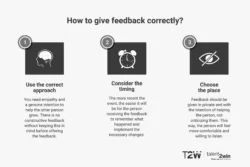
To learn in more detail how to offer effective feedback, it is necessary to follow these steps:
1. Use the correct approach
To begin, you must be aware that your comments are aimed at helping a person improve professionally. For that, you must have empathy and a genuine intention to help the other person grow. There is no constructive feedback without keeping this in mind before offering the feedback.
Considering the above, you must adopt an empathetic approach during the session and remain objective when giving feedback. The goal is to improve an action or a result, not to make value judgments about someone’s skills, aptitudes, or character.
Remember that you are looking to help the person work on a point of improvement, so you should focus on the problem and not on the person. For example, “Your report contained several errors” is more effective than “You are very careless with your reports.”
2. Consider the timing
Everything has an appropriate time and place. In the case of feedback, the appropriate time should be very close to when the action or behavior that needs to be corrected is noticed. The more recent the event, the easier it will be for the person receiving the feedback to remember what happened and implement the necessary changes.
3. Choose the place
On the other hand, regarding the place, it is not ideal to offer feedback publicly. No one wants to be corrected in front of the entire office. Feedback should be given in private and with the intention of helping the person, not criticizing them. This way, the person will feel more comfortable and willing to listen.
4. Use a structure
While the act of giving feedback should have a certain degree of naturalness, it is ideal to have a planned structure. It is advisable to follow the sandwich method. What is the sandwich method? It consists of focusing on positive aspects before and after the corrective feedback:
Initial positive comment – Corrective comment – Final positive comment
-
Initial positive comment
Therefore, according to the defined structure, the feedback session would begin with an assessment of the correct actions the person has taken in the development of the task in question. This step is key to avoiding a negative predisposition to the corrective comment.
- Corrective comment
The session continues with the corrective comments. Start by addressing the points to be corrected as specifically as possible. The last thing you want is for the person not to understand or not be clear about the aspects they need to work on. Be specific and detailed.
On the other hand, don’t just mention the aspects to correct; you should go a step further and offer suggestions for improvement. Now, saying “You need to be more proactive” will not be very effective. Instead, offer concrete examples and suggest specific actions the person can take.
- Final positive comment
Finally, conclude the session with a general balance that maintains a positive focus, recognizing that every mistake or misstep is an opportunity for improvement and personal growth. Although the sandwich method is the most effective, you should use it with some moderation and avoid overdoing it. If you use it too much, the recipient may focus only on the positive.
Importance of feedback
Effective feedback is the engine of continuous development. It offers a compass for the team, indicating where each member stands in relation to expectations, what they are doing well, and where they can improve. We cannot forget that it is also the basis for effective communication at work and a pillar of talent management.
Feedback is so relevant that it is part of Google’s organizational culture. Through its radical candor policy, Google encourages direct, honest, and constructive feedback; which is given peer-to-peer and top-down, with a focus on growth.
Let’s recap!
Offering effective feedback is a skill that requires practice, empathy, and a genuine intention to help the other person grow. Feedback in leadership is, without a doubt, one of the most beneficial actions an organization can take in its human capital.
Talent2Win offers borderless talent consulting solutions tailored to your company. If you would like to learn about our Executive Search, Talent Acquisition or RPO services, please do not hesitate to contact us.
